8 hours ago
1
In September, a former Cornell student sued the university and seven fraternity members, who she says drugged and raped her. Nobody was arrested; only two were expelled. According to her lawyer, some of the others were allowed to make up for it by writing an essay. All of which is to say: I understand why the phrase “male loneliness epidemic” makes women want to gouge their eyes out.
And still, I’m curious. Men are a lifelong academic fascination of mine. Also, they control everything, so if they’ve all gone off the deep end, I’d like to know. Or, as Luke Kennard puts it in his brilliant Booker shortlisted comic novel Black Bag: “When damaged men have money and influence, that’s a problem for the whole world.”
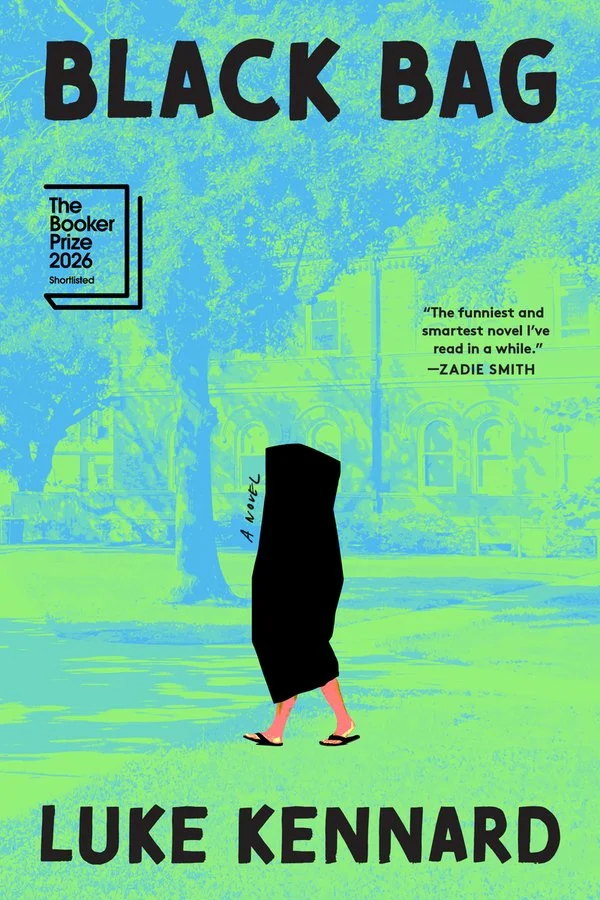
The book’s jacket calls it “an investigation into the crisis of masculinity.” The Sunday Times found it a meditation on how hard it is to be a man right now. One blurb sells it as “comic relief” from the manosphere, while another says it takes aim at “modern-day masculinity.” Even the Booker judges predicted we’d all be discussing what it says about modern men. I was interested.
And then, I read Black Bag. It’s about a guy who can’t make his rent.
The narrator is an unnamed 37-year-old London actor. On the first few pages, we learn that he hasn’t had a paid job in months. He’s behind on rent and most of his utility bills. In his words: “I have measured out my life in coffees I cannot technically afford.” Desperate for work, he answers an ad. A university professor, Dr. Blend, needs an actor to sit silently at the back of his lectures for a term, zipped into a black leather bag. It’s absurd and demeaning. It also gives our protagonist, for a few months, “a level of fiscal security I have never experienced in adult life.” He resolves to do a good job. He’s thrilled.
Almost immediately, it’s more than just a job to him. On his days off, he still zips himself back into his bag and shuffles around London. Soon he’s wearing the bag on the bus, in cafés, everywhere. “I would just as soon be black bag than whatever my self is,” he says. “What am I without black bag? Without black bag I am some pitiful and unremarkable man going around, doing things. Shameful.” When our narrator is zipped into his bag in the lectures, mind free to wander, he doesn’t imagine a life of fame, fortune, or comically large biceps, even though he is both an actor and a man. He plays out soft, slow fantasies of life in an isolated Swedish town where he works in the sawmill, where “my superiors would be supportive and gently amused as I learned the ropes.” His wildest escapist fantasy is having a decent boss. Kennard gives his narrator a job so stupid, and a subsequent sense of self so powerful, that the book becomes a masterful exploration of the dignity of showing up to work. Black Bag is more than a discourse on our forlorn men. It’s the most pro-labor novel of the year.
And yet, it’s been pegged as a “masculinity novel.” To be fair, the book is about a lonely man. Kennard writes beautifully of his protagonist’s isolation and struggle to communicate with those around him. As he says, regarding his parents: “What I want to say is thank you. English people have such a deep-seated suspicion of disingenuousness that we often forego gratitude altogether. It is feasible to go your entire life without ever expressing a single emotion just in case you didn’t mean it.” The man is lonely.
Black Bag is more than a discourse on our forlorn men. It’s the most pro-labor novel of the year.
But I wonder if there’s a marketing element, too: Male loneliness is so in right now. “The crisis of masculinity” is fresh and buzzy; “the crisis of rent” is old and dull. It’s more fun to talk about men being all messed up than it is to talk about oligarchy. But I worry that trying to disguise a crisis of capitalism with a crisis of masculinity plays into the hands of those same oligarchs. If we’re going to talk about what men need, we can’t avoid what’s currently on offer.
I’m not British, I’m not a man, I’m not an actor, and I have no interest in wearing a black leather bag, professionally or otherwise. But I live in America, where “masculinity,” as a political conversation, has curdled. MAGA’s plan for men is gender essentialism: Everyone else gets smaller so men have room to be “men” again. JD Vance wants to $9,000 per child, married couples only. The Heritage Foundation has asked RFK Jr. to go after the birth control pill, on the grounds that estrogen in the water is making male fish girly and also potentially doing something to our boys (???). Josh Hawley’s solution for men—laid forth in his painful book, Manhood—prescribes Bible study, early marriage, and absolutely NO porn or video games. Neither!! In the words of Secretary of War Pete Hegseth: “We are leaving wokeness and weakness behind. No more pronouns. No more climate change obsession. No more emergency vaccine mandates. No more dudes in dresses, we’re done with that shit.” The through-line is that masculinity is a fixed quantity. Bad actors—women, Democrats, trans kids, immigrants, feminists, Rosie O’Donnell, etc—have been siphoning it off, and the true patriots need to wrestle it back.
Very few of my needs are specific to my gender.
The whole premise is not merely offensive, but also misguided. My issue is twofold. First: The assumption that men’s needs are about their manhood. I don’t know what it’s like to be a man, but I do know what it’s like to be a woman. Very few of my needs are specific to my gender. I need food. I need health insurance. I need affordable housing. I need my daughter’s daycare to stop making up fake holidays to cancel school (no offense). And sure, I occasionally need a tampon. But if I had to pick between health insurance and tampons, I’d go with health insurance. I can always just wear black jeans, or better yet, a black leather bag. I don’t mean to suggest that different constituencies don’t have different needs, but boiling a person’s needs down to only their demographics disguises far more universal economic problems.
Second—and more importantly—these “masculinity” solutions shift the onus away from the people in power and onto the individuals. Sorry, guys, we don’t have policy solutions for you because we can’t raise taxes on our rich friends, but have you ever considered marrying younger? Praying more? Keeping your wife at home so she doesn’t outshine you? Having kids? Quitting porn? Getting your testosterone checked?
Kennard’s narrator, by contrast, tries none of these. What’s missing from his life isn’t “manhood,” it’s a stable and fulfilling source of income. And the numbers would suggest he’s not alone. In 1983, one in four working men belonged to a union. Today it’s one in ten. By 2010, NAFTA had cost the US nearly 700,000 jobs, according to the Economic Policy Institute, most of them in manufacturing: a field that’s 71 percent male. In response, Trump did NAFTA 2.0, plus a plethora of tariffs that nobody expected to bring the factories back. And the next version of government-sponsored job losses (AI) is likely to be even more widespread. Anthropic head Dario Amodei recently told Axios that AI could push unemployment as high as 20 percent, and then went back to building it. And still, we’ve seen no federal AI regulation. We’re living in a world in which a good job and reliable income are increasingly out of reach. Or, as our narrator says: “a life of quiet desperation is an impossible dream for my generation . . . We’d love nothing more than affordable accommodation to fail in.”
This affects everyone, but men fall under the umbrella of “everyone.” I don’t mean to suggest that men are more vulnerable to a bad economy than anyone else (all evidence would suggest the opposite). But I understand why it’s possible to conflate a crisis of capitalism with a crisis of masculinity. When our protagonist lists off reasons he doesn’t consider himself a “man,” one item reads: “I don’t have any money to speak of, am, in fact, flat broke.” It’s notable that when a man doesn’t have a job, it’s his masculinity that gets called into question. Why is joblessness related to testosterone, rather than a late-stage capitalist world order in which the top .1% owns the building you rent in, the company that laid you off, and the AI currently being trained to replace you? Just wondering.
Why is joblessness related to testosterone, rather than a late-stage capitalist world order?
Maybe what men need is what Kennard offers his narrator. He isn’t suffering from a shortage of manhood or an abundance of feminism. He’s suffering from a lack of meaningful work. Job protection. Compensation that makes him feel valued. We hear a lot about how “nobody wants to work anymore” (something people have been saying since the 1800s, at least), but the reality is that nobody wants to work a dead-end, underpaid job that’s tied to their health insurance and might vanish at any moment. That’s the whole point of unions: There is value in protecting good work. For men, and for everyone.
My toxic trait is that if I read enough about the masculinity crisis, I do start to feel sorry for men. And I felt for Kennard’s narrator, too. Kennard’s narrator is a man in crisis, after all—but not because there’s estrogen in the water supply. Because he doesn’t have a viable career path. Once he gets one, no matter how absurd, his identity crisis is lifted.
7 Stories About Men Confronting Toxic Masculinity
Sonora Jha, author of “How to Raise a Feminist Son,” recommends fiction in which men grapple with gender expectations

A crisis of masculinity is easier to talk about than a crisis of capitalism, because it doesn’t demand nearly as much action. Nobody has to raise a wage or regulate an AI company that incidentally funded your ballroom. And the actions it does require—keep women at home, restrict reproductive freedom, ban gender-affirming care—line up neatly with things our leaders wanted to do anyway. Very convenient, I see what you did there. But it’s more difficult to posit what Kennard does in Black Bag: Maybe there is no crisis of masculinity after all. Maybe there’s simply a crisis of capitalism that’s gotten so bad it’s now come for the men. Men don’t need a testosterone injection or a trans kid 2,000 miles away to get kicked out of the locker room; they need a union and a higher minimum wage. That would help us all.
Anyway, it’s a great read. I hope Kennard wins the Booker. Men could really use a win.
The post The Crisis of Masculinity Is Actually a Crisis of Capitalism appeared first on Electric Literature.