1 month ago
11
1 month ago
11
 Photo by Jackson Simmer on Unsplash
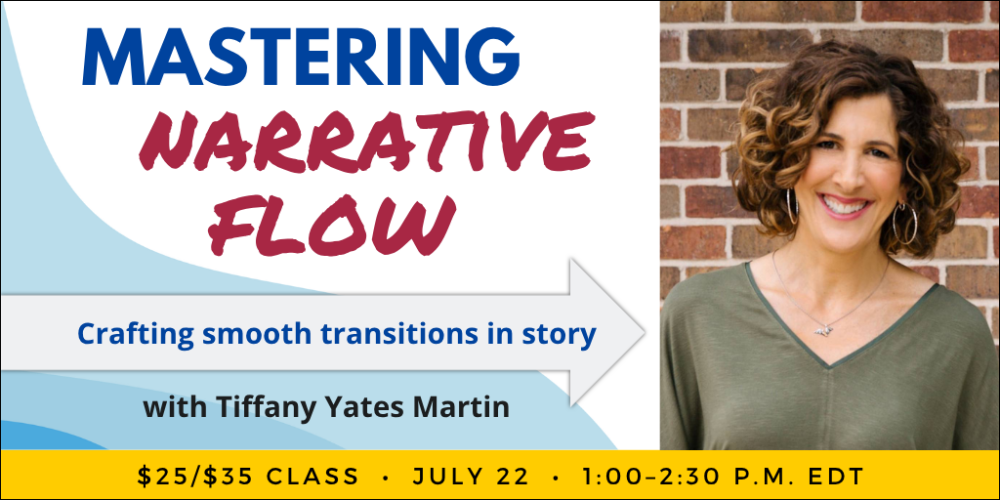
Today’s guest post is by editor Tiffany Yates Martin. Join her on Wednesday, July 22, for the online class Mastering Narrative Flow.
You’ve worked out a rock-solid plot, created strong character arcs, and managed to get it all on the page in your finished manuscript. So why does your story still feel choppy, disconnected, or episodic?
If you’re confident that other story elements are well-developed and in place, the issue likely lies in a common problem area: creating smooth transitions that link your scenes organically and give your story that propulsive narrative throughline.
Here are common pitfalls with transitions.
Missing connective tissue
The most common problem is that this connective material isn’t present at all—a result of misinterpretations of the oft-exhorted advice to start en medias res and winnow your prose down to a lean, mean momentum machine.
But without necessary transitional information that orients readers to what’s happening in the story and how it’s connected to what came before, they may feel confused and left to figure out the causal links and chronology. The story winds up feeling as if it’s hopscotching through a series of events rather than letting readers follow the characters in real time.
It’s essential to fill in clearly and relatively early in each scene a few critical things readers need to know: Who is the focal character, where are they, when is this relative to the last scene, what has happened since (if the action is not immediately contiguous), and what’s their state of mind and objective as a result?
This could be as straightforward as “The next morning, after a restless night that left her even edgier about their argument…” or it may entail a little more explanation. But leaving out this important “glue” risks confusing your reader.
Vague, empty, or clunky connective tissue
The reason underdeveloped transitional material isn’t effective is the same reason it’s ineffective anywhere in a story: vague, generalized writing leads to vague, generalized stories.
- “A few days later…” “Weeks went by…” “July 14”: Just summing up the passage of time isn’t sufficient to orient the reader, and it raises questions about what happened in the interim and how it affected the character. These phrases aren’t necessarily anathema in themselves, but likely you need a bit more than just chronology.
- “They got into the car and drove to the hospital; the drive took about twenty minutes. When they arrived they parked in the garage before going inside.” This is just logistical info, a GPS description that doesn’t tell readers anything about what happened during that car ride, the tenor of the character dynamics, or any character’s emotional state.
- “The sun was shining brightly. Birds chirped in the trees. A light breeze blew across the grass as they walked.” Great, we know the generic setting—but how is it relevant to the action of the story or the characters’ situations?
- “The next few weeks were busy. There was a lot to do, and the team worked hard. Finally, the project was finished.” This is almost entirely devoid of specifics that give readers a concrete picture of what the characters are doing, how it affects them, why it matters.
- “He got dressed, brushed his teeth, grabbed his keys and locked the door, walked downstairs to his car, and drove to work.” Meanwhile, the reader grew bored with such tedious, empty details, put the book down, and chose another off their shelves.
Overwriting transitions
Authors may overcorrect for the previous issue and fall victim to the opposite problem: meticulously spelling out much more transitional material than readers need. You don’t need to dedicate reams of narrative to bringing the reader up to speed. Just briefly lace in the necessary details relatively early in the scene (usually within the first few paragraphs).
Think of this the same way you weave in context throughout a story, without overwhelming them with info dump. For example: “The interrogation was a disaster, and by the time Kieran walked into the chief’s office to brief her he was certain she’d remove him from the case.”
Readers don’t need a full recap of the interrogation if we saw it in a previous scene—just a reminder to let us know where we are relative to the last action. And if we didn’t see that action on the page, a line or two offering specific further context on how or why the interrogation was a disaster is likely sufficient, unless the scene is key to the story in some way.
Summing up what should be shown
Which brings us to another reason your connective tissue may be leaving your reader out of the loop: If you’re summarizing as transitional material events that rightly belong in the story as real-time scenes, readers are likely to feel as if we missed a step.
What makes a scene important to show instead of summarize is the role it plays in the main story. Does the action that scene encompasses meaningfully advance the plot, move the character along their arc, raise the stakes? If so, it’s likely an essential piece of the story that readers want to live firsthand, rather than learn about secondhand, after the fact.
The same applies when a main character experiences a significant turning point, decision point, or crisis point—these are important shifts in their journey, emotional beats that are germane to shaping their actions and behavior throughout the story and to how and why they travel their arc, and thus merit dramatizing on the page.
And if the events are rife with juicy tension or suspense that’s relevant to the main story, then you may be doing yourself a disservice by summarizing it as transition rather than dramatizing it as a scene. What gives these elements their power in story is that they draw the reader in intimately, and let us live the action along with the characters, beat by heart-in-the-mouth beat.
Trailing transitional threads
Sometimes scene transitions may feel jarring to readers because the story seems to skip over important resolution and fallout from a previous event—usually some unresolved situation, tension, or cliffhanger. If two characters have a terrible argument, for instance, and the next scene moves to a subsequent scene that doesn’t acknowledge the impact and effect of it on the protagonist and their situation, it feels like the author has dropped a stitch.
Trailing threads tend to create missing shifts in the character’s emotional state, attitude, motivation, and objectives that leave readers wondering what happened as a result of the previous incident or development and what significance it’s had on the character and the plot.
As with most connective tissue, all that’s usually needed is a few lines offering readers a sense of a development’s resolution and its aftermath, and how it has shaped the character’s circumstances now, in the scene we’re about to see.
Episodic scenes
The simplest structural reason for scenes that feel disconnected is that they are: The plot isn’t causal but rather episodic—“this happens, and then this, and then this”—so the narrative feels like jarring jump cuts from event to event, rather than a smooth, fluid movie that lets readers feel as if we’re experiencing it along with the characters.
In that case, before you can patch together the story with connective tissue you have to address the more foundational story issues. (For more on writing causally related stories with strong, consistent momentum, see this post.)
But even if you have a propulsive, cohesive narrative throughline, if you haven’t stitched in the connective tissue that carries readers from one event to the next, your story is likely to feel disjointed, erratic, or confusing.
Transitional material may seem extraneous or trivial, but it’s crucial for the storytelling experience. The secret to effective transitions is to ensure they are necessary, relevant, specific, and as elegantly minimal as possible.
Note from Jane: If you enjoyed this post, join us on Wednesday, July 22, for the online class Mastering Narrative Flow.